“Eat, I pray you: will you have some more sauce to your leek? There is not enough leek to swear by.”
Every year I post my Puerto Rican Thanksgiving Turkey recipe; or what I term the “Boricua” Turkey. To recap: a Boricua (boh-ree-kuah) is a native born Puerto Rican. However, these days it could mean anyone of Puerto Rican descent whether they were born on the island or not. That being said, I’m going to depart from tradition this time around. I always post the recipe, and it is delicious since we season it up the turkey so that it tastes like pork, which was at one time the traditional dish for the holidays—until the pork was supplanted by the turkey just like they do on the mainland. Our holiday bird is more flavorful than its North American counterpart. That’s all well and good, but I’ve gotten complaints that I never post the stuffing, as it is noted in my cookbook. Puerto Rican Cuisine in America (Perseus Books – Running Press). So, here it is, our family’s traditional Puerto Rican stuffing for the Boricua turkey. Our recipe includes rum (to give it that Boricua taste). Note that the rum is boiled away in the cooking and only the flavor remains. One of the components that makes this stuffing unique.
RELLENO PARA PAVO
(Turkey Stuffing)
2 tablespoon olive oil
2 pounds lean ground beef or 1 1/2 pounds bulk pork sausage (for a spicier variation, Spanish chorizo can
be used), coarsely chopped
1 medium onion, peeled and chopped
1 pound mushrooms, washed and chopped
1 medium apple, peeled and chopped
Salt and ground black pepper to taste
Poultry seasoning to taste (optional)
1 cup seeded raisins, soaked in 1/2 cup warm water for 10 minutes
1 cup walnuts, chopped
8 cups bread crumbs
1/2 cup white Puerto Rican rum
1/2 cup chicken bouillon or broth
1. In a large skillet or kettle, heat olive oil and cook meat, stirring frequently until it loses its red color. If using sausage, it should be cooked until browned. Drain but reserve fat.
2. Add onions, mushrooms and apple. Season to taste with salt, pepper and poultry seasoning (if using), and sauté until apples are slightly softened. It may be necessary to add some of the reserve fat to keep mixture from sticking. Add drained raisins, walnuts and bread crumbs. Cook for about 3 minutes. Stir in white rum, chicken bouillon or broth and sauté for about 5 minutes more.
3. Remove from heat. When cool, stuff turkey about three-quarters full, and follow roasting instructions.
Yield: about 10 cups.
Note: Any extra stuffing can be placed in a covered glass casserole and baked along with the turkey for the last 45 minutes of cooking. Or it can be saved for later use and heated up with the leftovers. (I recommend baking at 350 degrees F. for 30 minutes).
Picture: courtesy of Fashion Belief
In the last few years, Szechuan-style Chinese cooking has caught on on both coasts. To many of us, after years of eating bland Cantonese-style food, Szechuan cooking was a revelation. It has a spicy, hot component because of its use of chili peppers. It should be noted that, initially, chili peppers were not used in Chinese cooking. They had their own milder variety, farago, also called Chinese pepper or Szechuan pepper. Then, when Portuguese and Spanish traders introduced chilies to the region in the 16th century, the cooking became even more peppery. Hunan cooking is part of this culinary tradition; but it is less well known than its Szechuan cousin. It is often lumped with Yunnan in the south as representative of China’s western regional style of cooking. But there are differences. Not only does it feature the subtle uses of hot spices within the food, it also engages hot and sour and sweet and sour flavor combinations.
Like its neighbors, Hunan does employ stewing and stir-frying techniques along with simmering and steaming. But Hunan cooks are fortunate that they have more ingredients and materials to work with and thus can do more and be more innovative with the ingredients prior to cooking. For example, a classic dish such as orange beef not only contains dried orange peel, but the beef is marinated overnight, washed, and marinated again in egg white, wine, and pepper, then cooked twice in a wok with fresh chili, ginger and orange peel. Another classic dish, General Tso’s chicken, has the chicken marinated in a mix of egg, salt, and pepper, and uses a sauce prior to cooking that has garlic, sugar, rice vinegar, rice wine, chili peppers, and scallions. Hunam lamb is not so outlandish or complicated, but it does have that exquisite Hunan taste. Serve with boiled rice.
HUNAN LAMB
2 tablespoons dark soy sauce
2 tablespoons rice wine or dry sherry
2 teaspoons cornstarch
1 teaspoon rice vinegar (or white wine vinegar)
1/2 teaspoon sugar
1/4 cup water
2 tablespoons peanut or vegetable oil
4 small dried hot chili peppers, coarsely chopped
1 teaspoon fresh shredded ginger
1 clove garlic, peeled and minced
2 stalks scallion, washed and thinly sliced on the diagonal
1 pound boneless lamb meat, sliced into thin strips (can use boneless lamb leg, lamb shoulder, or stew
meat)
1 teaspoon sesame oil
1. In a medium bowl whisk together the soy sauce, wine, cornstarch, vinegar, sugar, and water. Reserve
2. Heat the oil in a wok or skillet over high heat. Add the chili peppers, ginger, garlic, and scallion, and stir-fry for about half a minute.
3. Add the lamb and stir-fry until the lamb is no longer pink. Add the sauce mixture and cook, stirring, until slightly thickened (1 to 2 minutes). Stir in the sesame oil, remove from heat, and serve.
Yield: 4 servings.
Photo: courtesy of JING JING – Szechuan & Hunan Gourmet
Most authorities regard eggah as a dish in Arab cuisine that is similar to an omelet or frittata. Some would say it’s like a tortilla. I would say it’s more like an egg cake. In fact, eggah is nothing like an omelet (or omelette). To my mind, an omelet is something light and fluffy. Eggah is nothing like that. It generally has a filling of chicken, meat, vegetables or noodles. And it’s big, about an inch thick or more. You cut it into slices like a cake. And some cooks bake it in a rectangular dish and serve it in squares like Sicilian pizza.
In Arabic culture, eggah can be served as an appetizer, side dish or even an entree. And it can be eaten hot or cold. As noted, it can be cooked in the oven or on top of the stove. If doing the latter, you require a good, heavy frying pan, preferably cast-iron. Also, the dish should be cooked on low heat for the eggs to set. Butter, usually clarified butter, is used to cook the dish. I depart from this in that I prefer extra virgin olive oil. Another fact: in Iraq the dish is called kuku. I don’t know why.
EGGAH WITH CHICKEN AND NOODLES
1 1/2 pound boneless skinless chicken breasts, cooked and cubed. Note: you can also used leftover
cooked chicken—as long as it’s been boned
1 pound tagliatelle or fettuccine noodles
4 eggs
3 cardamon pods, cracked (these can be found in any Asian, Indian or Arabic store)
Salt and ground black pepper to taste
2 tablespoons olive oil
1/4 cup fresh chopped parsley
1. To cook chicken breasts: just place them in a pot with water to cover, bring to a boil, lower heat and cook until tender, about 15-20 minutes; then cube or cut into small pieces.
2. Cook the noodles according to package direction, but only until al dente. Do not overcook. You can add the chicken stock from the chicken breasts used in the water for boiling the noodles. Drain and set aside.
3. In a large bowl, beat the eggs. Add the chicken, noodles, cardamom, salt and pepper, and mix well to combine.
4. Heat oil in a large frying pan or heavy skillet. Add the egg mixture and cook over very low heat for about 1/2 hour, or until the mixture sets. Brown the top under the broiler for about 2 minutes.
5. Top with parsley and serve as is in the pan, cutting into slices. Or, if desired, unmold onto a serving dish and serve that way.
Yield: 4 to 6 servings.
Picture: courtesy of Pinterest

Mention eels to most anyone, and the first response is “Yuck.” But this seafood is prized in other parts of the world. In Asia and Europe ells are considered a delicacy, smoked eels in particular. Okay, so you say, “Convince me.” Well, let’s start with the fish itself. Eels come in two varieties: freshwater and marine. Freshwater versions such as the European eel and the American eel are eaten in the U.S. and Europe. Marine eels, such as conger and anago are popular in Japanese and Chinese cuisine. And they ain’t cheap. In Hong Kong, prices for select eel dishes range from $129 to $645 per kilogram (2.2 pounds). So, its a royal dish. Not to be out done, there’s even an American alternative rock band called the “Eels.”
We are more fortunate in that we can find eels at reasonable prices at the local fish store, Asian or Caribbean market. All I’m saying is give it a chance. You’ll discover how delicious and versatile they are. Yes, they look like snakes, and they’re slimy. But don’t let that deter you. Cook the suckers and you’re in for a treat. I recall that in the movie version of German author Guntar Grass’ book The Tim Drum, the main character, Oskar (who’s a dwarf, by the way), goes on an outing at the beach with his parents. On the shore they come across a horse’s head (yes, a decapitated horse’s head) that is swarming with eels crawling out of its snout, eyes and ears. The mother immediately gets sickened by the sight. The father, being more practical, takes the eels home, cleans them up and prepares a marvelous dinner. A smart man.
Given below are two simple recipes for cooking eels. Like Oskar’s family, you won’t be disappointed.
BROILED EEL WITH MUSTARD BUTTER
The eel:
1 1/4-to-1 1/2 pound skinned eel (cleaned weight)
2 tablespoons butter
Salt and freshly ground pepper to taste
The mustard butter:
4 tablespoons butter at room temperature
3 teaspoons mustard, preferably Dijon or Dusseldorf
3 tablespoons finely chopped parsley
1/4 teaspoon Worcestershire sauce
Tabasco sauce to taste
Salt and freshly ground pepper to taste
1. Preheat broiler to its highest setting.
2. Using a sharp knife, score the eel flesh top and bottom. To do this, make shallow 1/8-inch parallel incisions at 1/2-inch intervals. Cut the eels into 6-inch lengths.
3. In a baking dish, gently melt the butter and add eel pieces. Sprinkle with salt and pepper and turn the eel pieces in the butter until coated all over.
4. Place the dish of eel about 4 to 5 inches from the source of heat and broil about 1 and a 1/2 minutes. Turn the pieces and cook about 2 to 3 minutes longer. Pour off all the fat that has accumulated in the pan. Serve immediately with the mustard butter.
5. To make the mustard butter, combine all the ingredients for the butter and beat rapidly with a whisk or wooden spoon until well blended. Spoon equal amounts of the unmelted butter over the fish sections and serve immediately.
Yield: 6 servings.
EEL A L’ITALIENNE
My favorite eel recipe: cut about 1 1/2 pounds of eel or eels into chunks, season with salt and pepper and fry briskly in olive oil for a short time, just enough to stiffen the fish. Remove from the pan and in the same oil, brown 2 tablespoons of chopped onion. When the onion is nearly done, add a tablespoon of chopped shallots, and a 1/4-pound mushrooms, diced small. Put the eel back in the pan, add 1/3 cup white wine and 3/4 cup of tomato sauce. Simmer, with the lid on, for 1/2 hour. Place in a shallow platter, sprinkle with chopped parsley and tarragon, and serve.
Caption: courtesy of The Encyclopedia of New Zealand: Te hopu tuna – eeling
This recipe is a contribution from my late Uncle Phillip, von vivant, raconteur and ladies’ man extraordinair. Phillip was the black sheep of our family, mainly because of his lust for life. You could describe him as a lovable rogue; and he was a fabulous cook. According to him, the origin of this recipe is Bilbao, Spain, in the Basque country. Whether they prepare it this way in Bilbao, I do not know. But Uncle Phillip always stated they did.
Like most of his generation, Uncle Phillip had this thing about Spain and its culture. To a lot of older folk on the island of Puerto Rico, Spain is still regarded as the “mother country.” In fact, La Borinqueña,” the unofficial island anthem, has a phrase in it about the “Spanish motherland.” To us New York bred Puerto Ricans, or Nuyoricans, these sentiments are rather quaint. I have never been to Bilboa. Im sure I’d feel more at home in Lancaster, PA than in Bilboa any day. But I doubt I could find a genuine recipe for Bilbaina style fish in Lancaster, PA, or most parts of the U.S. for that matter.
Let me add that the recipe is from my first cookbook, Puerto Rican Cuisine in America (Perseus Books – Running Press). There are more like it in that tome. Enjoy.
PEZ A LA BILBAINA
(Fish Bilbaina Style)
1 2-1/2 to 3 pound striped bass, cleaned and scale but with head and tail still attached (can substitute
any other firm fleshed fish)
2 tablespoons olive oil
1 medium onion, peeled and thinly sliced
2 medium ripe tomatoes, thinly sliced
1 medium green bell pepper, cored, seeded and cut into 1/4-inch strips
1 8-ounce can tomato sauce
2 cloves garlic, peeled and finely minced
Salt and black ground pepper to taste
1. Preheat oven to 370 degrees F.
2. Wash fish, inside and out, and pat dry with paper towels.
3. With a sharp knife, make 3 to 4 vertical slits on both sides of fish.
4. Heat olive oil in a frying pan or skillet and lightly brown fish over moderate heat on both sides.
5. Remove fish to a baking dish large enough to hold it comfortably. Top fish with onions. Then layer with tomatoes, and finally with the green pepper strips.
6. Pour tomato sauce over the fish, and sprinkle with minced garlic. Season with salt and pepper.
7. Bake uncovered, for about 30 minutes or until fish flakes easily with a fork.
Yield: 4 servings.
Caption: courtesy of ian brodie

Marie Antoine Careme is regarded as the leader of what is called la grande cuisine Francaise. That is, the classic French style of cooking heavy on sauces, heavy on creams, heavy on decoration, heavy on everything. Careme had an impressive resume. At various times he was chef de cuisine to Czar Alexander I and the Rothschilds. But his recipes are daunting. Most are difficult to emulate, even in a modern kitchen. Case in point are his famous chartreuse dishes such as Chartreuse printuniere (Sping Chartreuse), Chartreuse à la parisienne, en surprise, and Chartruese de perdreaux, which he called “the queen of all entrees.” These were molded dishes using an assortment of vegetables, fowl, wild game, sausages, and a host of other stuff. His Paris Chartreuse even has truffles, pullets, fillets, forcemeat (meat mixture with fat), and lobster tail all baked in a cylindrical mold.
I took one look at these recipe and said, No way. It would take forever to do one of these things. But you have to give credit to the man. His list of classic French dishes is exhaustive. With such works as L’art de la cuisine au dix-neuvième siècle (The Art of the Kitchen at the XIX Century) and Le mâitre d’hôtel francais (The Mâitre d’ of the French Hotel) he not only discussed garnishes and accessories, but also took on such topics as the provisioning and organization of the kitchen. All that said, I did manage to find one recipe which I can identify with. And which under the circumstances, is not that difficult to make. So, kiddies, here’s your chance to create something on the grande mode of classical cuisine. This will surely impress family and friends. You’ll become the Julia Child of your set. The recipe is Rice Cake Glazed and Ornamented. I give it exactly as noted by Monsieur Careme.
RICE CAKE, GLAZED AND ORNAMENTED
Put 8 ounces of rice, boiled as usual, with the addition of a clove of vanilla, in a semi-globular mold, buttered; then turn it on a dish, and when cold, mask it all over with transparent apricot-marmalade. Decorate the top and the sides, according to your fancy, with pistachios, angelica, currants, verjus grapes, and preserved cherries. Serve it up, either hot or cold.
Yield: about 4 servings
Note: Verjus grapes are unripe, green grapes. You can substitute seedless green grapes if convenient.
Caption: courtesy of exclassics

So you’re asking, What the hell are duxelles? Simple: think of chopped mushrooms cooked in butter with shallots and wine. They’re cousins to stuffed mushrooms. Some describe them as a mushroom confit. Okay, what’s a confit? Confit is a term for various foods that are coked in oil or sugar and preserved. Often they are sealed and stored for future use. The term originated in the Middle Ages when fruits were cooked and preserved in sugar. Duxelles can be cooked and stored in this way as well.
All this mishigas can be ascribed to one Pierre Francois de la Verenne. He is recognized as the first great French chef of the modern era. He was the first to codify the Franco-Italian cuisine that had evolved into la grande cuisine Francaise or classic French cooking. His cookbook, Le Cuisinier Francois, was published in 1650, and is regarded as a landmark in the history of European cuisine. He was the first to describe stuffed mushrooms and (you guessed it) duxelles. Don’t let the fancy French moniker scare you. Duxelles are very easy to make, and they are delicious when added to sauces and vegetable. They also make great fillings for omelets, fish or meat dishes.
DUXELLES
1 stick butter
2 pounds fresh mushrooms, washed, drained, and finely chopped (stems and caps included)
2 shallots, finely chopped
3 tablespoons dry sherry or Marsala wine
Salt and ground black pepper to taste
1. In a medium saucepan or skillet, melt the butter over low heat (being careful not to burn it). Add mushrooms and shallots, and cook over low heat, stirring constantly until the mushrooms give up most of their liquid. Add more butter as needed.
2. Add dry sherry and cook about 5 minutes longer until the mushrooms are black in color. You want the mushrooms to be somewhat dry but not bone dry. Season with salt and pepper. You can serve as is or store in a tight jar or container. They’ll be good for 1-2 weeks in the fridge.
Yield: About 4 cups.
Note: Italians make duxelles as little differently. If you prefer the Italian style, add 1 teaspoon of lemon juice to the shallots and mushrooms and cook 4-5 minutes over moderate heat. Add 3 ounces of diced boiled ham, cook 5 minutes more, add 1/4 cup dry Madeira wine or brandy. Stir to mix until heated through.
Caption: courtesy of 500 Tasty Sandwiches
In our culture we love crabmeat, what we call “jueyes.” In our family, my father’s favorite rice mix was rice with crabmeat. Whether living in Spanish Harlem or Puerto Rico, my father would spend countless hours seeking a restaurant with the best recipe. However, none compared to my mother’s arros con jueyes.
Let me state that, if desired, you can prepare the crabmeat from scratch; and it’s best to use Caribbean crabs. Such a recipe is given in my cookbook Puerto Rican Cuisine in America p. 192-193 (Perseus Books – Running Press). But if you’re press for time and don’t want to bother with preparing the thing, you can use canned crabmeat. No one is going to fault you for it.
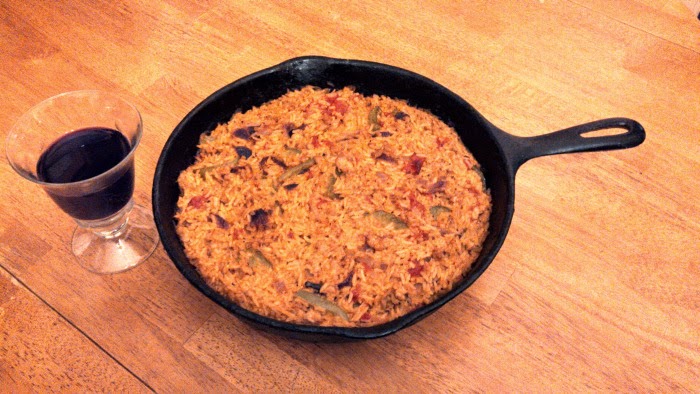
ARROZ CON JUEYES
(Rice with Crabmeat)
2 cups rice
1 tablespoon olive oil
2 ounces lean cured ham or salt pork, rinsed and diced
1 small green bell pepper, cored, seeded and chopped
1/2 cup finely chopped onions
1 clove garlic, peeled and finely chopped
3 sweet chili peppers (aji dulce), seeded and chopped (found in any Asian or Caribbean market)
1/2 cup tomato sauce
6 pimento stuffed Spanish olives
1 1/2 cups crabmeat
1 packet sasón accent (Goya makes a good one with coriander and annatto)
Salt and ground black pepper to taste
Water to cover rice
1. Wash rice under cold running water, and drain.
2. Heat oil in a heavy kettle or Dutch oven and brown ham over moderate heat.
3. Add bell pepper, onions, garlic and sweet chili peppers. Sauté for about 3 minutes.
4. Add tomato sauce, olives, and mix well.
5. Stir in rice, crabmeat and sasón accent.
6. Add water to cover contents in kettle by 1/4 to 1/2 inch above level of rice. Adjust salt and pepper to taste.
7. Bring to a boil. Cover tightly and simmer on low heat until water is absorbed and rice is tender ((about 20 minutes).
8. Uncover and simmer 5 minutes more if drier rice is preferred.
Yield: 6 servings.
Photo: courtesy of ifood.tv
When I was growing up, one of the favorite dishes we had in the family was stuffed eggs (think of deviled eggs). But our method was called stuffed eggs “Seville style.” My Uncle Phillip, of late memory, swore that this was the way they prepared eggs in Seville. I have no historical proof of this. We just took him at his word. We know that Seville (Sevilla – “Seh-Vee-Yah” in Spanish) is a city in Southern Spain. It was under Muslim rule for over 400 years and it could have been the Muslims who introduced this type of dish to the region. Again, this is all conjecture on my part. If somebody out there has more accurate information, please let me know.
The dish itself is very easy to prepare. All you need is eggs, olives, onion, mayo and Worcestershire sauce. That’s it. It’s quick and convenient and will impress family and company. The recipe is from my first cookbook, Puerto Rican Cuisine in America (Perseus Books – Running Press). Enjoy.
HUEVOS RELLENOS A LA SEVILLA
(Stuffed Eggs Seville Style)
8 hard boiled eggs
1/2 cup chopped pimento stuffed olives
1/2 cup finely chopped onion
1/4 cup mayonnaise
1/2 teaspoon Dijon mustard
2 teaspoon Worcestershire sauce
1. Slice eggs in half lengthwise and remove yolks. Set the hollow whites aside.
2. In a bowl, combine yolks, olives, onions, mayonnaise, mustard and Worcestershire sauce. Mix well.
3. Stuff the hollow egg whites with the egg-yolk mixture.
4. Place in a serving dish the refrigerator and chill.
Yield: 4 to 6 servings.
Photo: courtesy of Real Simple – Life Made Easier
© 2026 Oswald Rivera
Theme by Anders Noren — Up ↑