One thing you know about this blog is that I love shrimp. Just review the previous posts like Shrimp Aglio e Olio (1/9/15), Shrimp with Garlic (3/21/15), and Shrimp with Cream Sauce (1/2/16) and you get the idea. What I like about shrimp, apart from its texture and taste, is that it’s so easy to cook. Whether you broil it, steam it or stir-fry, the trick is quick cooking, 2-3 minutes over medium heat until its turns pink.
If there’s one drawback about it, is the preparation. That is, removing the shell and deveining. Here’s a secret. You don’t need to devein shrimp, unless you’re a purist (which I ain’t). In some cultures, they eat the shrimp whole, eyes and all. That vein down the back of the shrimp is part of the intestinal tract. Now, before you start thinking about eating intestines, you won’t fall ill from eating it. In Chinese restaurants, I’ve never seen anyone remove the vein. It’s all a matter of preference. Also, convenience. With small shrimp, no one even bothers. But even with large shrimp like prawns or jumbo, it could take hours to devein the thing. Fortunately, most suppliers these days offer shrimp that has already been shelled and deveined.
The recipes given can be done quickly and efficiently. The white bean ragout can be served over rice. With the shrimp and vodka, I prefer it over pasta, whatever type you like. But, if you want to serve it with a grain, go right ahead. In terms of cuisine, I discovered long ago, do what suits you best.
SHRIMP AND WHITE BEAN RAGOUT
(Note: I first had this dish in my young manhood, years ago, at one of my favorite watering holes, Ye Olde Tripple Inn at 54th Street between 7th and 8th Avenue. When I saw it on the menu, I told Mike, the owner, “I’ll have the “RAG-OUT.” He corrected me: “Dummy, it’s called “RAGOO.” To which I replied, ‘Okay, I’ll have the ‘RAGU.'” The Tripple Inn is no longer with us, but memories are made of this.)
Heat 2 tablespoons olive oil in a large nonstick skillet over medium heat. Add 1 pound large raw shrimp, 1/4 teaspoon each garlic powder and crumbled dried rosemary, plus salt and pepper to taste. Cook 2 minutes. Add 1 can (15 1/2 ounces) rinsed Great Northern Beans (white beans) and cook 2 minutes until heated through. Serve over rice. 4 servings.
SHRIMP WITH VODKA
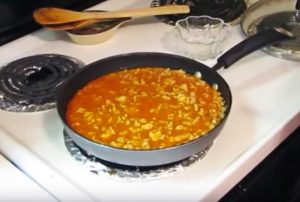
Heat 2 tablespoons olive oil in a large skillet over medium heat. Add 1 small onion, chopped; and 2 cloves garlic, finely minced. Cook, stirring, about 4-5 minutes, until softened. Add 2 tablespoons tomato sauce. Cook for 1-2 minutes. Stir in 1 cup heavy cream. Bring to a boil, add salt and pepper to taste, and let the sauce bubble until it starts to thicken slightly. Add 1 pound large raw shrimp to the sauce plus 2 tablespoons vodka. Cook, stirring, over medium heat 2-3 minutes more. Pour sauce over cooked pasta, either strand, tubular or other. Toss well and serve. 4-6 servings.


 Sofrito is ubiquitous in Caribbean cooking. One could safely say that Puerto Rican cuisine would be wanting without it. It is an aromatic mix of herbs and spices that is a base for cooking countless criollo dishes. This concept can be found in other cultures as well. One example is the Indian mix called garam masala which is also used as a base flavoring. Or kimchi, the fermented cabbage condiment, so popular in Korean cooking. The word sofrito is a generic term that has no correct English translation. “Frito” in Spanish means fried. Sofrito could be taken to mean stir-fried. Although this would not be entirely accurate. As the recipe shows, sofrito can be whipped up in a few moments’ time in a blender or food processor. And it can be stored in a closed tight jar the refrigerator for three to four days or, in the freezer compartment, indefinitely.
 The American Heritage Dictionary of the English Language describes cassava as a tropical American plant with a starchy root from which tapioca is derived. To us Latinos from the Caribbean, it’s yuka (yoo-ka). Yuka is most commonly served peeled and boiled with a bit of olive oil sprinkled on top. But it also yields a bitter or sweet starch known as manioc which is used in the making of farina and, of course, tapioca. For those interested in arcane terminology, manioc is a word of Tupian origin, attributed to the Tupis, a group of American Indian tribes living along the coast of Brazil and the Amazon River valley. To explorers from the Old World, this new food was a wonder.
 Coquito is what my folks called Puerto Rican moonshine. And they were not too far off the mark. Coquito is a made at home in the traditional way, mainly for special gatherings. Some people liken coquito to potent homemade eggnog. And it can be very strong, or very mild, depending on how much rum you put into it.
 Mofongo, I love the word. It’s pronounced just like it’s spelled. A popular Caribbean dish but undoubtedly of African origin. Basic mofongo is simply a mixture of crushed plantains with fried pork crackling served with a sauce. In the Puerto Rican version, we prepare it as individually shaped mofongo balls, similar to meatballs. Cuban mofongo differs in that the mixture is shaped into one large ball which is served in a bowl. More modern variations have this type of mofongo stuffed with beef or seafood. Whatever method you prefer, it is a delicious appetizer, side dish, or meal on its own.