Oswald Rivera

Author, Warrior, and Teacher

Category: all (page 66 of 78)

How to Cook Beans


Beans, beans are good for the heart; the more you eat, the more you . . .” Well, we all know the rest to that ditty. Fact is, beans are good for the heart. The lowly bean (or legumes—the fancy word) is a good source of thiamine, niacin and other components of the vitamin B complex series. They are also great comfort food. Think of a hearty French cassoulet casserole; Mexican refried beans; Boston bake beans; the three bean salad for barbecues; and the Middle Eastern hummus. Life would be sad indeed without beans. But how to cook the suckers? Easy enough to open up a can of beans but, for real flavor and texture, nothing beats fresh beans or the more common dry beans you find in 1 pound packages at the store. Be aware that the dry beans you get at the supermarket could be older (and drier) than last year’s leftover meatloaf. Thus they need to be soaked beforehand in water. And the more soaking time, the more tender the final product. That’s why I recommend overnight soaking rather than the quick soaking method where you cover the beans in water, bring to a boil, then cook uncover over moderate heat for approximately 2 minutes; and afterward let them soak for an hour.

The overnight method involves placing beans in a colander, discarding any broken or shriveled ones, and rinsing in cold running water. Then you place the beans in a pot with water to cover at least 2 inches.  Never use warm or hot water. In extremely hot weather it’s a good idea to soak the beans in the fridge. Ideally, one should change the water several times to prevent the beans from fermenting. After overnight or quick-soaking, drain beans and place in a heavy kettle or Dutch over with 2 quarts (8 cups) water and bring to a boil. Cover and boil over moderate-low heat until beans are tender (about 1 hour). From hear on you can finish up with any of the three basic bean recipes given below. Let me add, the recipes are good for almost any kind of legumes: black beans, red kidney beans, pigeon peas, small red beans, Lima beans, pinto beans, black-eyed peas, pink beans, chick peas, etc.

 BASIC BEAN RECIPE

A. Sofrito Method:
This method uses sofrito, an aromatic mix of herbs and spices which is used a a base for cooking countless Caribbean dishes. You can buy prepared sofrito in most supermarkets or Asian and Caribbean markets. If you want to make it from scratch then you can check my blog post of  11/08/10 which gives an easy sofrito recipe. Or, better still (for me), get it from my cookbook, Puerto Rican Cuisine in America  (Perseus Books Group—Running Press)

1. To the soaked beans, add 1 large potato, peeled and cut into 1-inch cubes; 3 tablespoons sofrito; 1 beef bouillon cube; 1 teaspoon salt; 1/2 teaspoon dried oregano; and 1/4 cup tomato sauce. (My mother, of blessed memory, would add 2 tablespoons dry red wine at this point—a tip she got from a Cuban friend). Mix well.
2. Cover and cook over high heat until water is boiling. This should take 5 to 10 minutes.
3. Lower heat and simmer, covered, for 30 minutes or until beans are completely tender and sauce has thickened somewhat.

B. Skillet Method:
1. Place the beans in a pot and boil in 2 quarts water as outlined above; but add half a medium green bell pepper, seeded, to water.
2. In a skillet or frying pan, heat 2 tablespoons olive oil. Add 1 medium onion, peeled and chopped; 1 clove garlic, crushed; 1 teaspoon dried oregano; 1/2 cup tomato sauce; and 1 tablespoon tomato paste. Saute on moderate heat for 5 minutes.
3. Add skillet contents to beans plus 1 large potato, peeled an cubed, and 1/2 teaspoon salt. Mix well.
4. Cover and cook over high heat until water is boiling (5-10 minutes).
5. Lower heat and simmer, covered, for 30 minutes or until beans are completely tender sauce has thickened.

C. Oven Method:
This is an oven method that is very popular in Italy, particularly in Tuscany. The beans are soaked overnight in the same manner, then rinsed and place in a pot or casserole. The rest of the recipe is as follows:

1. Preheat oven to 275 degrees F.
2. Add 1 small onion, peeled and chopped, to beans and water to cover by 1/2 inch.
3. Cover and bring the water to a near boil over low heat.
4. Place the pot in oven and bake until beans are tender (45 minutes to 1 hour). Make sure the water does not evaporate during cooking to below the level of the beans.
5. Remove from oven and add salt and pepper to taste. Let stand for about 10 minutes.
6. Drizzle a tablespoon or two of olive oil over beans and serve.

Note: the above recipes yield from 6 to 8 servings.

photo: courtesy of NewlyWed Nutrition

Pasta Salad


Waning days of summer. And it’s still hot out there in some parts. We’re still hooked on salads. And that’s where pasta salads come in. Contrary to popular opinion, pasta salads are not traditionally Italian. They’re an American innovation, just like Pasta Primavera; although they’ve become a part of the Italian repertoire. What makes pasta salads great is that they can be prepared in advance. They’re great for outings and picnics. They make good party food; and you can feed lots of people for minimal expense.

Any pasta type or shape can be used for these salads. My favorite has always been soba buckwheat noodles, cooked, drained, and tossed with toasted sesame seeds, a little soy sauce, scallions, and dash of sesame oil. This gives an Oriental twist; and it can be served hot or cold. But the two recipes included today are more traditional pasta salads. One is a simple salad perfect for summer: just red tomatoes, mozzarella, basil, parsley and a plain vinaigrette of olive oil and vinegar. The second recipe includes cooked chicken or turkey along with other veggies and white beans.

The fun with pasta salads is that you can experiment and use whatever combination fits, even adding seafood such as canned tuna or any other type of cooked fish, even mussels. You are only limited by your imagination.  The one thing to remember is never to soak the cooked pasta in cold water. This makes the pasta soggy, and you don’t want that. Simply cook the pasta al dente (to the tooth), and drain it thoroughly. Just toss the pasta with whatever dressing desired. However, if you’re using mayonnaise, it’s best to wait until the pasta has cooled before adding the mayo, or the mayonnaise may spoil. Other that that, go at it.

SIMPLE PASTA SALAD

1/2 cup olive oil, preferably extra virgin
1 tablespoon red wine vinegar
Salt and ground black pepper to state
1 teaspoon dried oregano
3 cups cooked penne or any other tube or shell-like pasta
3 ripe tomatoes, washed and diced
5 ounces mozzarella, diced
10 pitted black olives, sliced in half
1/2 cup fresh basil, rinsed and chopped
1/4 cup fresh Italian parsley, rinsed and chopped
 1. In a small jar or cruet, whisk together the olive oil and vinegar, salt, pepper, and oregano
2. In a large bowl, mix together the pasta, tomatoes, mozzarella, olives,basil and parsley.
3. Add the dressing and toss to combine.
    Yield: 4 servings.

PASTA SALAD WITH CHICKEN OR TURKEY

1/2 cup olive oil, preferably extra virgin
2 clove garlic, peeled and finely minced
1 teaspoon dried oregano
Salt and ground black pepper to taste

2 cups cooked, diced chicken breast or turkey
3 ripe tomatoes, washed and diced
1/4 cup pitted black olives, sliced in half
1 16-ounce can cannellini beans, drained
1/2 cup fresh basil, rinsed and chopped
1 green bell pepper, washed and chopped

3 cups cooked  bow-tie pasta, or any tube or shell-like pasta
1 cup mixed salad greens of your choice.

1. In a jar or cruet, whisk olive oil, garlic, oregano, salt and pepper.
2. In a large bowl, mix together the chicken or turkey, tomatoes, olives, beans, basil, and bell pepper.
3. Stir in the pasta. Add the dressing and toss to combine.
4, Stir in the salad greens, and serve.
    Yield: 4-6 servings.

photo: courtesy of ifood.tv

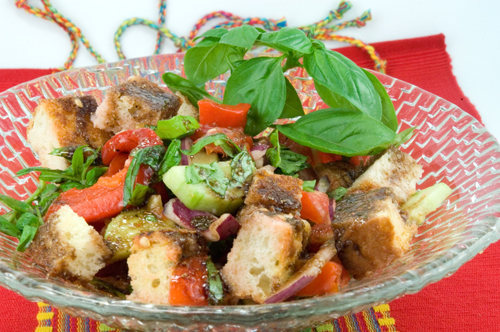
Panzanella

Panzanella Salad
It’s getting toward the end of summer; but it’s still hot out there in some parts. And, honestly, we’re getting tired of salads. So, how can we spice it up? Well, how about panzanella?  Right away you can tell from the spelling that it has the word “pan”—which translates to “bread” in Spanish or Italian. And you’d be right. Panzanella is a Tuscan bread salad that is popular in Central Italy, where it is also known as panmolle (pronounced: pan-moh-leh). The salad also includes tomatoes, mint and basil. Although it must be noted that, initially, before the advent of tomatoes, the salad was onion based. And it has a plain dressing of olive oil and vinegar, that’s it.  

What’s good about this salad is that you can use day-old bread, even stale bread, if necessary. You see, the bread is toasted in the oven before mixing with the other ingredients. That means the bread doesn’t get squishy like croutons, and its crunchy taste prevails. The recipe given below is a basic panzanella. And the great thing about this is that you can add any other veggies you desire: blanched peas, green beans, fava beans, mushrooms, broccoli, etc. You can even add pieces of ham, salami, or cooked chicken to it. The possibilities are endless.

PANZANELLA

2 cups day-old bread, preferably a good sourdough or crusty baguette, torn or cut into 1-inch pieces
2 medium tomatoes, diced
1 medium zucchini, cut into 1/4-inch ring, and then each ring cut in half
1 small red onion, peeled and thinly sliced
3 cloves garlic, peeled and finely minced
1/2 cup fresh mint, washed, dried, and roughly torn
1/2 cup fresh basil, washed, dried, and julienne

1/2 cup fresh dill, washed, dried, and roughly chopped
Handful fresh Italian parsley, washed, dried, and chopped
1/3 cup extra virgin olive oil
1/4 cup red wine vinegar

Salt and ground black pepper to taste

1. Preheat oven to 375 degrees F.
2. Spread bread out on a baking sheet or pan and bake until golden, about 14 minutes, flipping once halfway. Then let cool.
3. In a large bowl, toss together the bread pieces, tomatoes, zucchini, onion, garlic, mint, basil, dill, and parsley.
4. In a small bowl, mix olive oil, vinegar, salt and pepper. Pour over bread salad, Toss. Adjust seasonings, if necessary; and let stand for at least one hour for flavors to blend before serving.
    Yield: 4-6 servings.

photo: courtesy of a foodie affair

Enhanced by Zemanta

Watercress


When I was a kid I remember these old movies where the British upper classes would sit down for tea in some opulent parlor and have watercress sandwiches with their Earl Grey or Darjeeling. And I would ask myself “What the hell are watercress sandwiches?” In fact, “What’s a watercress?” It wasn’t until later on that I discovered the watercress plant to be a singular edible experience. Watercress is a perennial plant native to Europe and Asia; and is one of the oldest leaf vegetables consumed by the human family. So it’s been around for a while.  And it’s good for you. King Xerxes of ancient Persia fed it to his soldiers to improve their vigor. It was used by the English navy as a remedy for scurvy. It has a peppery, tangy flavor and is chock full of vitamin C, calcium and iron. It is also mentioned in the Talmud as an agent for stopping bleeding when mixed with vinegar, Not only that, a study conducted at the University of Southampton found that it may inhibit the growth of breast cancer.

Watercress sandwiches aside, it’s prevalent in soups and salads. But you can use it as a puree for roasts. And other ways in sandwiches as well: substitute watercress for the iceberg lettuce; add it to burgers with onions; top your grilled cheese with it—the possibilities are endless. The recipe given below is an easy way to use watercress: just a simple watercress-avocado salad with some olives thrown in.

WATERCRESS-AVOCADO SALAD

1/4 cup olive oil
1 tablespoon red wine vinegar
2 cloves garlic, peeled and minced
1 teaspoon dried oregano
Salt and freshly ground black pepper to taste
2 bunches watercress, tough stems removed, chopped
1/2 cup parsley, chopped
1 avocado, peeled and cut into chunks
6-8 black pitted olives, halved

1. In a small bowl, whisk together the olive oil, vinegar, garlic, oregano, salt and pepper. You can also use a jar or cruet: add ingredients and shake.
2. In a large bowl, add the watercress and parsley. Toss together with the dressing. Gently mix in the avocado and olives. Add more salt or pepper, if desired.
    Yield: 4 servings.

photo: courtesy of STALLS – Buckland Apple Day

What the hell are Chayotes?


One of the more esoteric forms of bianda, or root plants, that we use is our cooking are chayotes. So what are they? Well, a chayote is a pear-shaped tropical fruit whose flavor is akin to that of a cucumber. It is normally light green in color. It has a large pit and edible flesh and skin, though in Puerto Rican cooking we normally peeled the things before eating. It’s mild flavor lends itself to a variety of dishes. Even though it’s categorized as a fruit, we use it as a vegetable, that’s why it’s included in our root plant pantheon. The chayote has a variety of names depending upon the place and region. They are known as christophene or christophine, mirliton or merleton, Guatila, Centinerja, Pipinola, pear squash, guisquil, Cidra, chucha, choko, and even cho-cho. Chayotes, according to the experts, are either native to Mexico or Central America. Though it’s assume the word itself is a Spanish derivative of the Aztec word chayohtli (pronounced chah-yoh-tleel). And they are very popular throughout Latin America and the Caribbean.

In our cuisine, we prepare them peeled, boiled until tender, cut into chunks, and  serve with olive oil and vinegar. We also serve them in salads, as in the dish noted below, ensalada de tomate y chayote (tomato-chayote salad).

Where can you get these things? They are available in any Caribbean markets and most Asian markets. Better stocked fruit markets will also carry them. Most Americans don’t know about chayotes, and that’s a shame. They are great as appetizers, as a side dish for seafood, fowl or meat, and (as shown) in salads. Once you taste them, they will become a part of your repertoire. And, the recipe given below is from my first cookbook, Puerto Rican Cuisine in America.

ENSALADA DE TOMATE Y CHAYOTE
            (Tomato-Chayote Salad)

3 medium-sized chayotes, peeled and cut in half lengthwise
1 bunch watercress
2 cups cherry tomatoes, cut in half
1/4 cup ripe pitted olives, sliced in half

 Dressing:
6 tablespoons olive oil
2 tablespoons red wine vinegar
2 cloves garlic, peeled and finely minced
1/4 teaspoon dried oregano
Salt and ground black pepper to taste

1. Place chayotes in a pot or saucepan with water to cover by one inch. Cook in boiling water until fork tender (5-7 minutes).
2. Drain, remove seeds and cut into bite-sized chunks.
3. Cut off and discards the tough stems of the watercress. Rinse under cold water and spin or pat dry.
4. In a bowl, combine chayotes, tomatoes, watercress and olives.
5. Combine dressing ingredients in a cruet or tightly covered jar. Shake well and pour over salads. Toss and serve.
    Yield: 6 servings.

photo: courtesy of Specialty Produce

Zabaglione

Two Zabaglione Served in Stem Glasses with Lady Fingers

Martino Rossi, nee Martino da Como, nee Martino de Rubeis, nee Giovanni Rosselli, was also known as Maestro Martino (Martino the master), presumably because of his cooking prowess as shown in  his four manuscripts known as Libro de Arte Coquinaria. This is an extremely important book in the history of cuisine. It was the first cookbook that had somewhat precise recipes and was well organized. It was printed in Latin in 1475, then in Italian, French, and English; and it was a popular treatise well into the 1700s.

In his magnum opus, Martino Rossi describes a dessert comprised of eggs yolks, sugar,cinnamon, and sweetish wine. He calls it Zabaglione (roughly translated: eggnog). Today, Zabaglione is one of Italy’s most famous desserts. Rossi says that Zabaglione should be served when “it soils the spoon.” (translation: when it is so thick it sticks to the spoon). Modern Zabaglione is made just prior to serving, usually in a copper sauce pot, and should be served immediately after it has thickened.

ZABAGLIONE

6 egg yolks
1 cup sugar
1/2 teaspoon cinnamon
1/4 cup marsala wine
1 tablespoon white wine

1. Mix  all of the ingredients in the top of a double boiler. Cook over boiling water, beating the mixture constantly until it warms and thickens.
2. Remove from heat and continue beating until the mixture is fluffy. Serve in a serving bowl or individual cups or glasses. The Zabaglione, though thickened, should be soft, smooth, and light. One may have to add more or less sugar and/or wine depending on the consistency desired, some prefer it heavier, some prefer it lighter.
   Yield: 4 servings.

Note: In some quarters, modern day Zabaglione is served over Italian macaroons (amaretti). Simply crumble the macaroons in the bottom of a serving bowl and pour the Zabaglione on top.

Photo: courtesy of StockFood/Paul Poplis Photography, Inc.

Green Salad for the Ages

While I was doing research for my second cookbook (title: The Pharaoh’s Feast in the U.S.; and Feasting with the Ancestors in the UK), I came across some fascinating facts about ancient cooking. For instance, the ancient Romans had a dish that consisted of stuffed door mice That’s right, as in a mouse. The Babylonians loved wild pigeons. And the Egyptians of the dynastic era enjoyed figs, dates, and pomegranates, not only as desserts but throughout the meal. More enticing, they loved vegetables; especially strong tasting vegetables such as garlic and onions.  These, along with other vegetables, were often served as a salad with an oil and vinegar dressing. Thus, I came up with a simple green salad using vegetables ancient Egyptians may have enjoyed.

Let me add, my green salad for the ages is perfect as a summer dish for these hot, humid days. Add a crusty loaf of bread and a cold beer (the ancient Egyptians loved beer), and you have it made.

GREEN SALAD
(From Dynastic Egypt)

1 small bunch celery (about 3/4 pound)*
3 large ripe tomatoes, sliced into half-moons
2 medium-sized cucumbers, washed, scrubbed, and slice
1 medium red onion, peeled and thinly sliced
2 tablespoons red wine vinegar
2 tablespoons olive oil (extra-virgin is best)
Juice of half a lemon
Salt and ground black pepper to taste
1/2 teaspoon ground cumin

1. Wash celery under cold running water. Remove the root ends and leafy tops and cut the ribs into 1/2-inch pieces. Place in a bowl or on a platter.
2. Add the tomatoes, cucumbers, and onion. Toss to mix.
3. In a cup, combine the vinegar and olive oil. Add the lemon  juice, salt, and pepper. Stir and pour on the salad. Sprinkle with cumin and serve.
    Yield: 5 to 5 servings.

*Green beans can be substituted for the celery. In this case, take 1/2 pound of green beans, trimmed and broken into bite-sized pieces, and cook or steam until crisp-tender. Drain and rinse in cold water, mix with other ingredients, and add the dressing.

Photo: Courtesy of FineDiningLOVERS

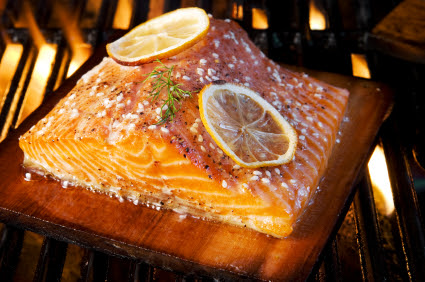
Rum-Marinated Salmon

Like most Americans, I love to grill. But there is just so many burgers, hot dogs and grilled chicken that I can take. I’m always experimenting with out-of-the-ordinary grilling dishes. Here, in the Rivera household, we enjoy grilled lamb for instance, and grilled seafood. And while experimenting with seafood, we discovered this rum-based marinade. I come from a culture where rum is used copiously, not only with imbibing, but with cooking. So why not a rum marinade for seafood, in this case, salmon? The thing about grilling with spirits is that the alcohol content cooks away with the grilling, and one is left with the flavor of the liquor. For this dish I prefer a dark rum, preferably añejo, that is, a rum that is aged over four years. But you can use regular white rum, if desired. Nothing is set in stone where a good, flavorful dish is concerned. 

The other good thing about this recipe is that it’s very easy and quick: 15 minutes total. The marinating process itself can be from 5 hours or overnight. But once that’s done, it’s a snap to make this dish. Also, you can also use the leftover marinade as a baste for grilling chicken or other meat.

RUM-MARINATED SALMON

1/2 cup olive oil
2 teaspoons sesame oil
4 tablespoons soy sauce
1/2 cup dark rum
2 tablespoons dark brown sugar or maple syrup
4 cloves garlic, peeled and minced
3 drops Tabasco sauce (or hot chili sauce)
4 salmon fillets (about 1 1/2 pounds), with skin left on

1. First, make the marinade: in a small bowl, whisk together the olive oil, sesame oil, soy sauce, rum, sugar (or maple syrup), garlic, and Tabasco.
2. The day before the grilling, place the salmon in a large zip-lock bag and add the marinade. Then place the the bag in the refrigerator for at least 5 hours or overnight, turning the bag over at least once in the process so the the fillets will be totally infused with the marinade.
3. Next day, place salmon pieces on the grill, skin side down. Cook for 5 minutes. Turn carefully with a spatula and cook 2-3 minutes more or until desired doneness.
    Note: If you don’t have a grill, you can also broil in the oven. Simply place salmon on a broiler pan or aluminum foil and broil on one side only (do not turn) for 5-6 minutes or until done. 
    Yield: 4 servings.

Photo: courtesy of The Grill Boy

Tropical Salad

 The hot, hazy, lazy days of summer call for salads. It’s only natural. Who wants to spend hours or even minutes slaving over a hot kitchen (even with air conditioning) when the humidity and temperature outside are sucky? The salad given below is called (giving a nod to the weather) a “tropical salad.” Why is is tropical? Simple; it contains fresh mangoes—and a splash or rum for vigor.

I like ripe fresh mangoes. I enjoy them as a snack, a dessert, and my favorite concoction: chunks of mango in a round champagne glass with sparkling champagne poured over the mango. It’s a scrumptious, sexy way to start the or end the evening. The recipe given does not contain champagne. It’s a typical salad for a hot summer day, and it’s from my second cookbook,  The Pharaoh’s Feast (Four Walls Eight Windows); also published in the UK as Feasting with the Ancestors (Sutton Publishing).

TROPICAL SALAD

1/2 bunch watercress
2 ounces fresh mango, peeled and cut julienne style into strips
2 ounces red onion, peeled and julienned into strips
2 ounces cucumber, peeled and julienned into strips
1 scallion, diced
1/4 cup fresh orange juice
4 tablespoons olive oil
Splash of  white rum
Salt and ground black pepper to taste
1 teaspoon fresh chopped mint

1. Rinse the watercress under cold running water and pat dry with paper towels.
2. Place in a salad bowl and add the remaining ingredients, tossing all together.
    Yield: 2 servings.

Photo: courtesy of Drizzle Oils

Enhanced by Zemanta

Scones—Blueberry Friday!

If you’ve ever had a typical English breakfast, then you know what scones are. Think of an English breakfast biscuit, but on the sweet side. I like scones, especially when I discovered that on the Star Trek series, Deep Space Nine, it was the favorite breakfast dish of Dr. Bashir, one of the main characters on the show. Scones are a dense, rich pastry of Scottish origin, where it has been served since 1513. In Scotland it evolved as a quick bread that made its way to English tables to accompany tea. They come in several versions including soda scones (made with baking soda), potato scones, or griddle scones (which are cooked on a griddle). Some say the word “scone” comes from the ancient capital of Scotland (Scone, Scotland), where ancient Scottish monarchs were crowned.

My Seattle friend, Paul Goldstein, has a sweet tooth for scones. And this is his recipe. Now, scones come in various shapes: triangles, rounds and squares, with round being the most popular these days. They are sweet since the often contain such fruit as raspberries, cranberries, raisins. etc. Although this recipe calls for blueberry scones, you can use whatever flavored scones you like. Also, you can bake your own scones, but Paul goes the easier route—just buy them at the store or supermarket. An 18-ounce pack will yield you six scones. This is a very easy recipe to make that you can enjoy either for breakfast or as a quick dessert. Either way you can’t go wrong.

BLUEBERRY FRIDAY SCONES

2 blueberry scones
1 pint vanilla ice cream (preferably French vanilla)
1 pint blueberries, or more if desired
Whipped cream

1. Cut the scones in half. Spoon ice cream about 1/2-inch thick over each scone.
2. Place blueberries around the outside of the scones and then top with a generous amount of whipped cream. That’s it.
    Yield: 4 servings.

Photo: courtesy of Bulldog Baked Goods

Enhanced by Zemanta
Older posts Newer posts

© 2026 Oswald Rivera

Theme by Anders NorenUp ↑