Oswald Rivera

Author, Warrior, and Teacher

Page 49 of 86

Fettuccine with Tomatoes, Garlic and Caramelized Onions

The waning days of summer, but good ripe tomatoes are still in season, and I indulged every chance to enjoy them. I won’t have such a treat during the cold winter months (it’ll be Italian canned tomatoes). Thus I posit another recipe featuring tomatoes. This time it’s fettuccine with tomatoes loaded with garlic and something unique: caramelized onions. The fettuccine, or any pasta with tomato sauce is a well-known favorite. The caramelized onions are something else.  For the record, the onion recipe comes from the monthly magazine, Cook’s Illustrated (September & October 2017, Number 148). The recipe intrigued me. I have my own method of making caramelized onions. But this one was different that a baking soda solution is added to the dish. It rendered a novel tangy taste.

Again, let me state that any pasta, tubular or string can be used in this recipe. We happen to have fettuccine on hand, and that was it.

FETTUCCINE WITH TOMATOES, GARLIC AND CARAMELIZED ONIONS

1/2 cup olive oil
5 large cloves garlic, thinly sliced
1 1/2 pounds plum tomatoes, cored and chopped
1/4 teaspoon crushed red pepper
Salt to  taste
1 pound fettuccine
3 large onions, halved and slice through root and 1/4-inch thick
3/4 cup plus 1 tablespoon water
2 tablespoons vegetable oil
3/4 teaspoon salt
1/8 teaspoon baking soda

  1. In a large pan or skillet, heat olive oil over moderate heat. Add garlic and cook, stirring, until soft and fragrant, about 2 minutes. Add tomatoes, crushed red pepper, salt, and cook, stirring, until the tomatoes break down and form a sauce., about 20 minutes.  Transfer to a bowl and set aside
  2.  Meanwhile, cook the  pasta according to package directions until al dente.  Drain, but reserve 1/4 cup of cooking liquid.
  3.  While pasta cooks, bring onions, 3/4 water, and salt to a boil, in the same skillet as before, over high heat. Cover and cook until water has evaporated and onions start to sizzle, about 10 minutes.
  4.  Uncover, reduce heat to medium-high and,  with a spatula, gently press onions into sides and bottom of skillet. Cook, without stirring onions, for 30 seconds. Stir onions, scraping from skillet, then gently press into sides and bottom of skillet again. Repeat pressing, cooking and stirring, until onions are softened, well  browned, and slightly sticky, 5-10 minutes.
  5.  Combine baking soda and remaining 1 tablespoon water in a small bowl. Stir baking soda solution into onions and cook, stirring constantly, until solution has evaporated, about 1 minute. Transfer to a bowl and set aside.
  6.  Place the sauce back in  the skillet, add the pasta and 1/2 cup of cooking water to the sauce, and toss over moderately-low heat until coated, about 2 minutes. Stir in the onions. Transfer to a serving bowl and serve.
    Yield: 4-6 servings.
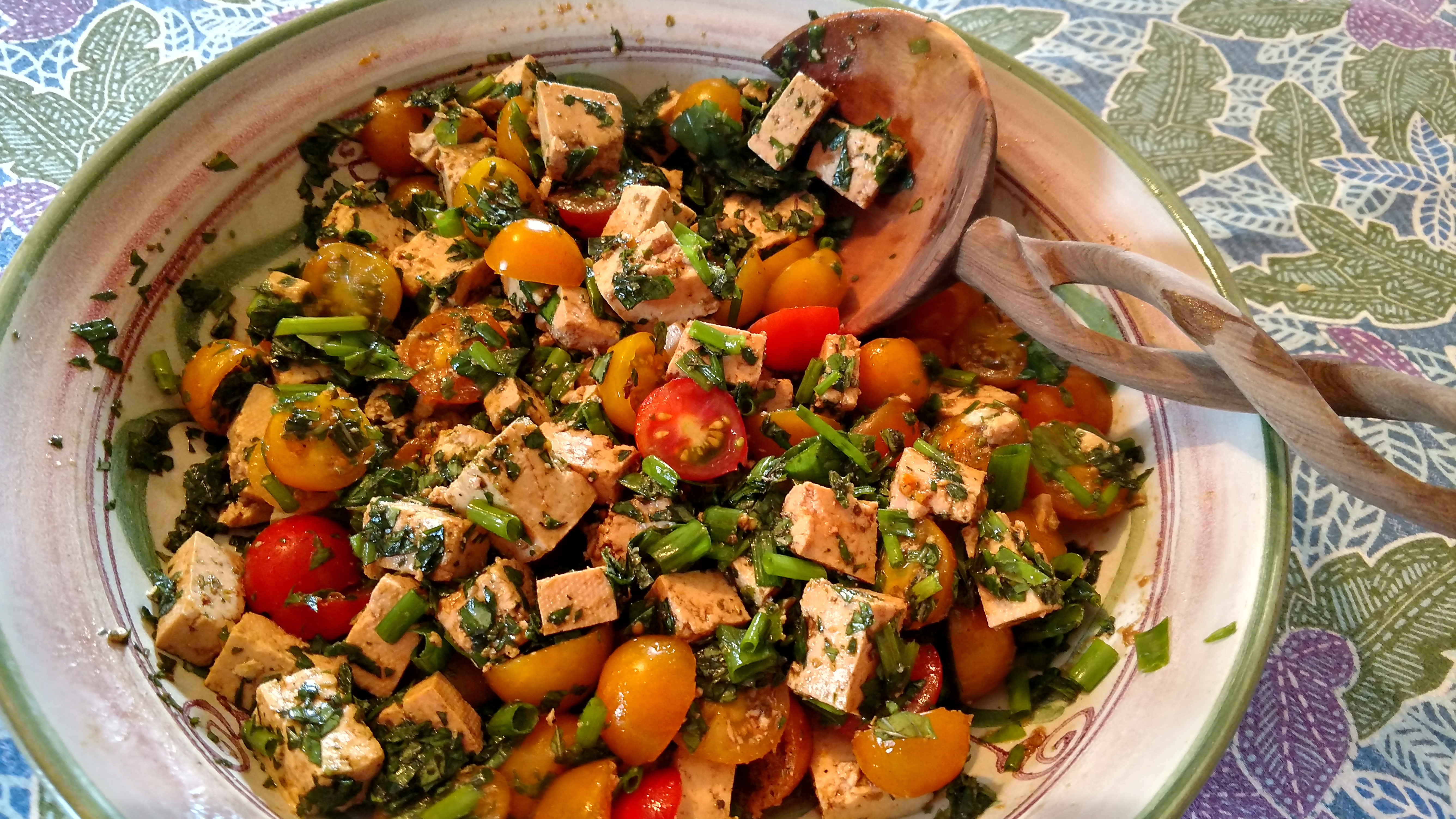


Tofu Salad

Waning days of summer, but it’s still hot in certain areas; and salads are king. Which means one has to become inventive.  There are so many ways of making a  good salad, and so many ingredients that can be used, apart from the usual greens and tomatoes. You have seafood salads, beans salads, pasta salads, steak salads, ext. So, how about a tofu salad? Why not? Everything else has been added to the canon. With tofu we have a unique, healthy alternative to the usual  norm.

Tofu is an acquired taste. An there’s a reason fort that. The problem with tofu is , that on it’s own, it’s rather bland. And, ironically, this is also its greatest asset: it can take on whatever flavors are added to it via herbs, spices or seasonings. In this tofu rending I gave it an Asian slant using using soy sauce and sesame oil along with basil, garlic, oregano and scallions rounding out the dish. You can have it as a salad entrée by itself; or you can serve it over plain steamed rice for variation.

TOFU SALAD

1 pint cherry tomatoes, washed and halved
1 package (20-oz) extra firm tofu, rinsed and sliced into 1/2-inch cubes or chunks
3 tablespoons soy sauce
1 teaspoon sesame oil
1 teaspoon red wine vinegar
1/2 cup shopped scallions
1 tablespoon fresh chopped oregano or 1 teaspoon dried
1/2 teaspoon garlic powder
Freshly ground  black pepper to taste
A pinch of brown sugar
3/4 cup chopped fresh basil
1/2 cup chopped fresh mint

  1. In a salad bowl (or any medium bowl that’s convenient), toss the tofu with the tomatoes.
  2. Add soy sauce, sesame oil, vinegar, scallions, oregano, garlic powder, pepper and sugar. Stir gently to combine.
  3. Stir in basil and mint, and serve.
    Yield: 4-5 servings.


Croquetas – Spanish Croquettes

Croquetas is one of the most popular tapas dish in Spanish cuisine.  They are very common in bistros in Spain, where they are enjoyed as a tidbit with dry sherry. In my family we savored them, but not as tapas appetizers. We made them as big as meatballs, to be served as an entrée.

Croquetas are usually accompnied with aioli, a Mediterranean sauce made with garlic and olive oil. In our version we add mayonnaise.

So, add a little Iberian flare to your dinner. Other than sherry, the dish goes great with any dry white wine, or red, for that matter. In our family, we never stood on ceremony where the wine was concerned—whatever you liked, was okay.

 CROQUETAS

1 package (12-oz) bacon
1 medium onion, chopped
1 red medium apple, chopped
3/4 cup
1/2 stick unsalted butter
3 cups milk
Salt and freshly ground pepper to taste
3 eggs
1 cup flour
1 cup breadcrumbs

Aioli

1/4 cup mayonnaise
1 teaspoon roasted peppers
Juice of half a lemon
Salt to taste

           1. In a medium skillet, add the bacon and onion and cook over medium heat until the onions are soft and
translucent, about 5-7 minutes. Add the apple and cook until it begins to release water, about 4
minutes. Whisk in the butter and cook until melted. Add 3/4 cup flour and cook for about 2 minutes. Add the
milk, a little bit at a time. Cook, whisking constantly, until the flour absorbed, about 3-4 minutes. Transfer
the mixture to a medium bowl. Cover with plastic wrap and place in the fridge to chill.
2. Meanwhile, make the aioli: in a medium bowl, mix the mayo, roasted peppers and lemon juice. Season  with
salt and pepper.
3. In a medium bowl, whisk the eggs. In another medium bowl, add the 1 cup flour. And in a third bowl, add the
breadcrumbs. Remove the mixture from the refrigerator. Using your hands, form into balls.  Again, we like
them big, about 1 1/2 to 2-inch rounds. Dip each ball into the flour, the eggs, and the breadcrumbs.
4. In  a large saucepan add enough vegetable oil to come four inches up the side of the pan. Or you can use any
deep fryer (we use a Fry Daddy). Heat the oil until very hot, add the breaded balls and fry until golden brown,
about 1 1/2 to 2 minutes. You may have to do this batches since they are large  croquetas. Using a slotted
spoon, transfer the croquettes to paper towel-lined platter. Continue until all are fried. Serve hot with the aioli.
Yield: 4-6 servings.


Pork Tenderloin

 Pork tenderloin is perfect when roasted or slow cooked on the stove in a rich sauce. Since it’s still grilling season, I decided to try it that way. My fear was, how do I get juicy tender meat on a grill and not a charred slab with a raw interior? I know friends who have tried grilling pork tenderloin and it doesn’t come out right. On the stove-top that’s no problem, slow cooking will always get you tender meat. I figured the only way this could be accomplished was by using  lower than usual heat, and constant turning of the meat.

Turns out the technique was okay. I got a well-seared meat where the interior was fairly cooked. Now, I use a gas grill. How this will turn out on a charcoal grill, I do not know. Perhaps someone can try it on a charcoal grill and let me know how it comes out. Also, I decided to add a simple spice rub with maple syrup, cumin and coriander. This is optional. You can use whatever seasoning desired, even plain salt and pepper will work. You can also substitute honey for the maple syrup.

This time of year, zucchini is plentiful. Thus, I cooked a bunch of zucchini with the thing. If desired, you can grill whatever veggies come to mind. However, when using potatoes, I’ve discovered it’s best if they’re cut no bigger than half inch rounds.

GRILLED PORK TENDERLOIN

1 teaspoon salt
1 tablespoon maple syrup or hone
1/2 teaspoon ground cumin
1/2 teaspoon ground coriander
2 pork tenderloins (about 12-16 ounces)
2 medium zucchini, sliced into 1/2-incg round
Olive oil

  1.  In a small bowl combine salt, maple syrup, cumin and coriander.
  2.  Rinse  pork tenderloins and pat dry with paper towels. Rub spice mixture evenly on both tenderloins.
  3.  Turn grill to high, using all burners. Cover, and heat until hot, about 15 minutes. Leave primary burner on high, but turn off other burners.
  4.  Place tenderloins on oiled cooking grate. Cover and cook , turning every 2-3 minutes, until browned on all sides, about 8-9 minutes.
  5.  Brush zucchini  slices with olive oil. Move tenderloin to cooler side of grill. Place zucchini on hotter middle center of grill. Cover and cook until charred and softened, about 5 minutes. Continue turning tenderloins every 2-3 minutes. Once pork registers 140 degrees on instant read thermometer, it’s done. It could be you may have to remove zucchini before pork is done. Once both tenderloins and zucchini reached desired level of doneness, remove from grill. Place zucchini on a plate, and tenderloins on a carving board. Tent pork with aluminum foil and let rest 8 minutes.  Slice about 1/2-inch thick and serve with zucchini (or any other veggie desired)
    Yield: 4-6 servings.


Steak Salad

Summertime is salad time. But one gets tired of the usual greens topped with dressing. So, how ’bout a steal salad? That’s right: a Steak Salad. If you like steak and who doesn’t? (Unless your a vegan). And if you like salads, this is tailor-made.

Now, for a steak salad you can use whatever steak meat you like, even chuck steak—which is perfect for this entrée, since the meat is cut thin and doesn’t need prolonged cooking. I used top round; but want to go with something fancier, no problem. The carnivores in your family will love this dish, even if it is a “salad.”

 STEAK SALAD

1 large potato, scrubbed but not peeled, cut into  1/2 to 1-inch chunks
2 tablespoons red wine vinegar
Juice of half a lemon
1 tablespoon Worcestershire sauce
2 cloves minced garlic
1/4 cup olive oil
1/2 cup sour cream
3/4 cup crumbled blue cheese (can substitute mozzarella, if desired)
Salt and freshly ground black pepper to taste
3 tablespoons olive oil
1 1/4 pounds steak,  about 1 to 1 1/2-inches thick
2 tablespoons fresh chopped oregano or 1 tablespoon dried
1 package spinach, rinsed and dried
2 large tomatoes, cut into small chunks
2 medium zucchinis. sliced into rounds, then each round sliced in half

  1. Place potatoes in a medium pan with water to cover, and boil until tender (5-6 minutes, depending on thickness of potato chunks).
  2.  Meanwhile, while potatoes are cooking, whisk together in a small bowl the vinegar, lemon juice, Worcestershire sauce and garlic. Add the olive oil slowly in a stream, whisking it in. Whisk in the sour cream and stir in the blue cheese. Add salt and pepper to taste. Set aside.
  3.  Season steak on both sides with salt, pepper, and oregano. Heat 3 tablespoons olive oil in a large skillet over high heat. Add steak and cook for 5 minutes on each side for medium rare (longer for medium or well-done). Transfer the steak to a platter and let it rest for about 8 minutes. Add any juice from the steak skillet to the blue cheese dressing.  Slice the steak very thinly at an angle across the grain.
  4.  In a a large salad bowl, combine the spinach with the tomatoes and zucchini. Add the salad dressing and toss the salad. Top with the steak slices.
    Yield: 4 to 6 servings.


Mushrooms and Sausage

Two of my favorite edibles are mushrooms and sausage. So why not combine the two?  And here it is, the dish given below. I added a sweet note by adding raisins and, instead of the usual dry wine as a stock, I decided on a sweet wine: it could be sweet sherry or even muscatel. Remember, back in the Bowery, the old days, when cheap  muscatel was the favorite of the old drunks? Those days are gone—you can’t afford the rents in the Bowery these days unless you’re rich.  I wonder what the old rummies are drinking now?

In this entrée, in terms of mushrooms, any wild mushroom, such as chanterelle, is preferred. I used a combination of crimini and shitaki.

MUSHROOMS AND SAUSAGE

3 tablespoons olive oil
1 pound mild pork sausage, casing removed, cut into 1-inch rounds
1 medium red onion, peeled and thinly sliced
2 cloves garlic, peeled and minced
1/4 cup sweet sherry
1/2 pound  wild mushrooms, cut into 1-inch  pieces
3 fresh thyme sprigs
1 bay leaf
2 tablespoons raisins
2 tablespoons pine nuts
Salt to taste
2 tablespoons flat-leaf parsley, chopped
Juice of 1/2 lemon
1 bunch fresh leaf parsley, rinsed and dried (can substitute curley endive or chicory, if desired)

  1. Heat 2 tablespoons olive oil in a large pan or skillet over medium heat. Add sausage and brown on all sides until cooked through, about 4 minutes. Transfer sausage to a plate and set aside.
  2.  Reduce heat to low, add onions and cook, stirring, until onions are soft and translucent, about 5 minutes. Add garlic and cook 2 minutes more. Increase heat to high and add wine. Cook until alcohol evaporates. about 30 seconds.
  3.  Reduce heat to medium. Add mushrooms, thyme and bay leaf.  Cook until mushrooms brown, 3-4 minutes. Return sausage to pan; add raisins and pine nuts. Cook, stirring, until nuts are toasted, about 2 minutes.  Stir in parsley. Remove  pan from heat.
  4. In a small bowl, whisk remaining 1 tablespoon olive oil with lemon juice. Season with salt, and toss lettuce with enough dressing to coat lightly.
  5.  You can serve the mushrooms with sausage on a large platter atop the red leaf lettuce. Or you can divide mushrooms and sausage  with salad on  four individual plates.
    Yield: 4 servings.


Chuletas A La Parrilla – Grilled Pork Chops

This is the Nuyorican way of grilling pork chops. Grilling season  inspires us in the myriad ways of cooking meat. In this one we use the spices traditional to criollo cooking.  For the recipe given you can use bone-in pork chops or loin pork chops. Both will work well, but grilling time may vary.

For this recipe I decided to add grilled plum tomatoes. A good addition to to the meat, and all topped with a tasty vinaigrette.

CHULETAS A LA PARRILLA
(Grilled Pork Chops)

2 tablespoons olive oil
1 tablespoon mustard (pref. Dijon)
1/4 teaspoon freshly ground pepper
1 tablespoon fresh chopped oregano or 1 teaspoon dried
1 tablespoon capers, rinsed and drained
4 pork chops, about 2 1/2 pounds, 1-inch thick
Salt and ground black pepper to taste
4 plum tomatoes, halved
2 teaspoons olive oil

  1. Brush grill with vegetable oil. Preheat grill to medium-high.
  2. In a small bowl whisk together the olive oil, mustard, pepper,  and oregano. Stir in the capers and mix well.
  3.  Season pork chops with salt and pepper. Grill until just cooked through, 5-6 minutes per side.
  4. Meanwhile, brush plum tomatoes with olive oil. Grill, cut-side down until charred, about 2minutes. Turn and grill 1 minute more. Transfer to a plate.
  5.  Serve pork chops with tomatoes and topped with vinaigrette.
    Yield: 4 servings.


Pegao–Crusty Rice

We Puerto Ricans have a love affair with rice. It is the main standby dish in our culture. There’s a reason why rice became so ubiquitous in our cooking. Rice was introduced to Puerto Rico by the Spaniards. It became the main meal during the Spanish occupation simply because it was relatively cheap to buy. That, plus ease of cooking, endeared it to our cuisine.  From the lowly side dish to the main course as featured in a seafood and meat laden paella, the love affair has evolved and deepened.

Nuyoricans as well as islanders cannot do without this grain, be it plain boiled rice, saffron rice, yellow rice, whatever. To some of us, a meal without rice would be incomplete. Almost like that old tune about love and marriage. What’s interesting about all this is that, in our family, the best part of the meal is what we call the pegoa, or that crust at the bottom of the rice pot. This is something that is traditional to our cooking, as least with the older generation. In fact, in some cases, the pegao (peh-gah-oh) is reserved for an honored guest. The rice is be cooked long and slow, so that when it’s served, that crispy crust at the bottom of the pan remains for a fortunate one to savor.

Then I discovered that our culture is not the only one that has this penchant for the rice crust. Persian cuisine also has a version of it, which they call tah dig (pronounced “tah-deeg”). This pegao thing is universal. There is something about that crunchy, even slightly burnt residue at the bottom of the pot that is irresistible to some. And almost every Latino household has a pan in which they make rice. It’s usually cast aluminum or stainless steel. To me, the best pagao is from a cast-iron pan. Again, this is a matter of opinion. One more thing, it won’t work with a non-stick pan.


Directions

  1. Wash 2 cups rice in cold water at least three times and drain to rid it of starch. What is in Pennsylvania Dutch country is known as “washing in several waters.”
  2. Heat 3 tablespoons olive oil in a heavy kettle or pot. Add rice and stir until grains are opaque, about 1-2 minutes.
  3. Add water to cover rice by ¼ to ½ inch. Some folks us the first knuckle of their index finger as measure for the water. Either way method is okay. Add salt to taste.
  4. Bring water to a boil. Cover and simmer on low heat for 40 minutes. By that time the liquid should all be absorbed, and the pegao formed. The longer it cooks, the more crusty the pegao. Serve the rice as you would with any meal, and then fight over who gets the pegoa.

Yield: 4-6 servings.


Note: You can add saffron threads (1/4 teaspoon) or turmeric (1 teaspoon) to the water for yellow rice. Or, for a deeper color, tomato sauce (1/4 cup). This will make the pagao even tastier.


Biftec con Romero y Límon

 A reader of ours, Yvonne Ortiz, recently sent me an email, “What happened to the Rican recipes???” Good question. She has a point. As of late I haven’t posted that many “‘rican” recipes.” Apart from my novels, I wrote one of the first Puerto Rican cookbooks of the modern era, Puerto Rican Cuisine in America. That immediately got me noticed as an “authority” on criollo cooking. I don’t know about the “authority” part, I’m just a foodie who likes to cook and eat good food. I’m not a gourmet, I’m more of a gourmand, one who takes hearty pleasure in eating. And that encompasses all cuisines, be it Puerto Rican or not. I grew up on criollo cooking. But, in my young manhood, living in vibrant New York City, I came across all cultures and cuisine, everything from Jewish (either Sephardim or Azkenazy) to Latin American, Asian, Polynesian, African, you name it. And it increased my palate and appreciation. My blog is not just simply confined to “‘rican” cooking. It explores cooking worldwide (with a non-cooking comment now and then to liven things up). Like the martial arts, all cuisines are equally good. It just depends on the practitioner of that cuisine to make it great.


In our family, beloved Uncle Phillip had a saying: “I want enough money to feed my belly and my friends’ bellies.” It became the motto of our family. It made no difference what the cooking was, as long as it was good and wholesome. But, Yvonne, dearest, just to keep the fans happy, here’s a ‘rican recipe. Enjoy it with family and friends. Basically, it’s a good steak cooked with rosemary, garlic, and lemon. We call it Biftec con Romero y Límon.


Ingredients

4 good quality steaks, T-bone, strip loin steaks, or club steaks, about 1 ½-inches thick
3 tablespoons olive oil
3 cloves garlic, peeled
8 whole black peppercorns
1 teaspoon salt
1 tablespoon minced fresh rosemary leaves or 1 teaspoon dried
Juice of half a lemon


Directions

  1. Rinse steaks under cold running water and pat dry with paper towels.

Put garlic cloves, salt, pepper, and rosemary leaves in a mortar. Pound with a pestle until crushed. Add one tablespoon olive oil, and mix thoroughly.

  1. Rub seasonings into the steak.
  2. Heat 2 tablespoons olive oil over medium-high heat in a large skillet or frying pan (I prefer cast-iron). Add steaks and cook steaks 5-6 minutes per side (depending upon thickness, for medium, slightly less for rare, and more for medium-well).
  3. Transfer meat to a large platter, sprinkle with lemon juice, and let rest 10 minutes before serving. In the Rivera family we preferred serving the steak whole per person. If desired, you can carve in slices, if that is your preference.

Yield: 4 servings.

SHRIMP AND GRITS

Two edibles I love are shrimp and grits. Normally we have them as separate dishes: shrimp for lunch or dinner, and grits for breakfast. What if we combined the too? In that vein, I’m told shrimp and grits is a popular dish down south. So I decided to give it a try. Below are two dishes for shrimp and grits. One is basic creamed grits with shrimp; the other is shrimp and grits with spinach. Try ‘em both. See which one works best. With either one, you won’t be disappointed.


CREAMED GRITS WITH SHRIMP

1 ¼ cups milk

½ cup instant white grits

½ cup light cream

4 tablespoons butter (about ½ stick)

Salt and black pepper to taste

2 tablespoons olive oil

1 pound raw shrimp, peeled and deveined

¼ cup larger beer (do not use dark beer or ale)

Juice of I lemon

6 cloves garlic, chopped

1 tomato, chopped

2 teaspoons fresh chopped tarragon (or 1 teaspoon dried)

  1. Bring milk and grits to a boil in a heavy saucepan, whisking constantly. Reduce heat and simmer until tender, stirring frequently, about 5 minutes. Stir in light cream and 2 tablespoons butter. Season to taste with salt and pepper. Set aside and keep warm.
  2. Heat olive oil in a medium skillet over medium-high heat. Add 1 onion, finely sliced; and sauté until golden. Add shrimp and cook for 1 minute. Add beer, lemon juice, and garlic. Simmer until shrimp is just opaque in center and sauce is slightly reduced, about 2 minutes. Stir in tomato, tarragon, and remaining 2 tablespoons butter.
  3. You can serve by either placing grits in one large platter topped with shrimp and sauce. Or you can divide grits among 4 plates, each topped with the shrimp.

Yield: 4 servings.


SHRIMP WITH GRITS AND SPINACH

2 cups water

2 tablespoons butter

½ cup instant white grits

1 5.2-oz round of Boursin cheese

½ cup grated sharp cheddar cheese

Salt and ground black pepper to taste

1 pound raw shrimp, peeled and deveined

3 cups spinach, washed and rinsed

1 tablespoons fresh chopped oregano (or 1 teaspoon dried)

1 cup grape tomatoes, washed and halved

Parmesan cheese

  1. Bring water and butter to a boil in a heavy saucepan. Stir in grits, return to a boil, lower heat and simmer, stirring frequently until tender, about 5 minutes.
  2. Stir in Boursin and cheddar cheeses, salt and pepper. Add shrimp and cook, stirring, until cooked through, about 4 minutes. Stir in spinach and oregano, and cook until spinach is wilted, about 2 minutes. Garnish with tomatoes, and top with a generous amount of Parmesan cheese.

Yield: 4 servings.


« Older posts Newer posts »

© 2026 Oswald Rivera

Theme by Anders NorenUp ↑