Oswald Rivera

Author, Warrior, and Teacher

Category: all (page 75 of 78)

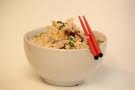
Fried Rice

Nothing speaks to us more of what we consider “Chinese” cuisine than fried rice. Problem is, it ain’t Chinese, it’s an American invention. It’s part of that overall catchphrase of what in known in the trade as “Chinese-American” cooking. Think of chop suey, egg foo young, chow mein, etc. They did not originate in China. The were invented in the good ole U.S.A (just like fortune cookies). And it all has to do with the Cantonese influence on American cooking.

Large scale immigration from Canton in southern China to the U.S. in the 1800s assured that this Americanization of Chinese cooking would take hold. The Chinese immigrants who flooded to California to work on the Pacific Railroad were constrained by the lack of authentic ingredients and vegetables that had represented their diet back home. They had to make do with what was available. Not only that, if they went into the restaurant business they had to make their dishes palatable to Western tastes. It’s amusing to think that someone from the Chinese mainland would come to this country and go in search of genuine American chop suey, chow mein, or fried rice.

Fried rice is a very easy dish to make. All you need is rice. And there’s an argument here. Some people swear that genuine fried rice should be done only with the sticky Chinese style of rice or something like Nishiki premium grade rice (I know, it’s Japanese, but some consider it of better quality). I cook fried rice with the good old long grain variety such as Carolina brand or even Uncle Ben’s. That’s what my friend Eddie Hor, of late memory, always used. This is his recipe.

It should be noted that, in some fried rice recipes, the eggs are cooked along with the rice. Eddie would cook scrambled eggs separately and then add the eggs to the rice. Also, one can use light soy sauce or dark soy sauce if you want a darker color.

You can add other ingredients to this basic recipe, and make it vegetable fried rice, or shrimp
fried rice, or whatever (you can even cook it with Spam). Be creative, let your imagination reign.

BASIC FRIED RICE

4 tablespoons peanut oil or olive oil (I prefer the olive oil)
2 large eggs, lightly beaten
Ground black pepper to taste
4 cups cooked rice
2 tablespoons soy sauce
1-2 scallions, or as many as desired, washed and coarsely chopped

1. In a wok or frying pan, heat 2 tablespoons oil over medium-high heat and add the eggs. Cook, stirring, until they are lightly scrambled, seasoning with pepper. Remove the eggs to a dish and set aside.
2. Clean out the wok or pan with paper towels. Add the remaining 2 tablespoons oil and, when hot, add the rice. Stir fry for a few minutes over medium-high heat, using chopsticks or a wooden spoon to evenly cook the rice.
3. Stir in the soy sauce and scallions. When rice is heated through and has achieved desired color, spread the scrambled eggs over the top. Serve immediately.
Yield: 4 servings.

Reblog this post [with Zemanta]

Food and Revolution


“A shortage of bread has been suggested as the cause of the fall of
Rome, the French Revolution, and the Russian Revolution of 1917.”
The Story of Bread by Ronald Sheppard and Edward Newton

While doing research on my latest book, which covers the topics of food and war, I was really taken by how food, or the lack of it, can cause social distress. By that I mean, chaos and revolution. We fat Americans are really lucky. We’ve never had to face a nationwide shortage of food. Even during the Depression there were mechanisms to keep most of us fed. Charities and other social structures provided if, nothing else, soup kitchens and other food outlets. Sometimes I wonder what would happen if the discrepancy between the very rich and the very poor became such that millions of us died of starvation. I tell you what happen: mass revolt.

There is no more vivid example of this than the French Revolution. Many myriad causes are attributed to that upheaval but most prominent was the class differences in that society. Especially in terms of food consumption. It was the contradiction of great excess and terrible poverty. The monarchs and aristocrats feasted royally while the starving peasants, well, starved. When a catastrophic famine hit in the late 18th century, the price of bread rose up nearly 90 percent. The peasants depended on bread to sustain themselves, but there was none to be had; and food shortages in 1788-89 finally ignited the revolution.

The profligate lifestyle of the royals became glaring. While people died of hunger on Parisian streets, the excesses and arrogance of the royals, aristocrats and the clergy (yes, the Church was part of the problem) continued unabated.

In good times peasant food consisted mainly of bread and gruel (a pottage made of ground beans or soup with vegetables and perhaps a little meat thrown in). When famine hit, even this was no longer available. In contrast, the royalty had it better, much better. Below is a menu for a supper given for Marie Antoinette, the consort of King Louis XVI. Yeah, you could say she ate well. The menu comes from the imperial archives as quoted by L’Almanach des Gourmands pour 1862, by Charles Monselet. Here is her majesty’s dinner:

Four soups: Rice soup, Scheiber soup, Croutons with lettuce, Croutons unis pour Madame

Two main Entrees: Rump of beef with cabbage, Loin of veal on the spit

Sixteen entrees: Spanish pates, Grilled mutton cutlets, Rabbit on the skewer, Fowl wings a la marechale, Turkey giblets in consomme, Larded breasts of mutton with chicory, Fried turkey a la ravigote, Sweetbreads en papillot, Calves’ head sauce pointue, Chickens a la tartare, Spitted suckling pig, Caux fowl with consomme, Rouen duckling with orange, Fowl fillets en casserole with rice, Cold chicken, Chicken blanquette with cucumber

Four Hors D’Oeuvre: Fillet of rabbit, Breast of veal on the spit, Shin of veal in consomme, Cold turkey

Six dishes of Roasts: Chickens, Capon fried with eggs and breadcrumbs, Leveret, Young turkey, Partridges, Rabbit

Sixteen small entremets (menu stops here)

And all this for one person. Supposedly, when a group of starving women marched on the palace at Versailles, demanding bread, Marie Antoinette’s response was that if they didn’t have bread, “Let them eat cake.” Whether she ever said such a thing is open to question. It did seal her fate , and that of the king. At the height of the revolution, in 1793 they were both sent to the guillotine and had their heads chopped off.

Moral of the story: Beware. Piss off the people, take away their food and their sustenance, and you reap the whirlwind.

Reblog this post [with Zemanta]

Cooking With Wine – Part III


One of the most fool-proof methods of cooking wine is poaching. That is, simply simmering the food with wine as the liquid. You can poach vegetables, meat or fish. They are all good, but poaching goes great with fruit. It can render a marvelous dessert dish, as noted in the recipe below. Just simmer any substantial fruit (apples, peaches, plums, etc.) in a sweet wine. The wine can be can be a sweet sherry, Marsala, port or other. I’ve chosen pears, and Sauternes, a dessert wine from Bordeaux.

PEARS POACHED IN SWEET WINE

1 cup Sauternes
1 cup water
1 cup brown sugar
Rind and juice of 1 lemon
4 pears, peeled and cored
1 cup whipping cream
1 tablespoon pear brandy (optional)

1. In a medium pan, combine wine, water and sugar.
2. Add rind and juice of lemon . Simmer over low heat for 5 minutes.
3. Add pears into the syrup. This must be done immediately after the pears have been peeled and cored. Simmer pears for 10-15 minutes depending on ripeness.
4. Remove pears to a serving platter. Boil syrup over high heat until half has been boiled away.
Pour remaining syrup over pears.
5. Serve chilled with whipped cream flavored with pear brandy if desired.
Yield: 4 servings.

Reblog this post [with Zemanta]

Brisket For Passover


In my young manhood I was introduced to the ritual of Passover by some Jewish friends. They invited me over for a traditional Passover Seder, and I was fascinated by the whole concept. Passover, I discovered, commemorates the ancient Hebrews’ deliverance from slavery in Egypt. It begins on the 15th day of the month of Nisan as reckoned by the Hebrew Bible. Nisan is the first month of the Hebrew calendar and is comparable to March and April in the Christian calendar.

According to the Book of Exodus, when the ancient Hebrews left Egypt, they were in such a hurry to get out that they had no time to wait for the bread they had prepared for the day’s meal to rise so it could be baked. In remembrance of this occasion no unleavened bread is eaten during the course of Passover. It is a seven day holiday of the Feast of Unleavened bread. So Matza, a flat unleavened bread has become the symbol of the holiday. The word “Passover” comes from pasach whose meaning is assumed to be “He passed over,” referring to God “passing over” the homes of the Hebrews during that time in which ten plagues struck Egypt, forcing Pharaoh to release the Hebrews from bondage.

Passover is celebrated on the first night with the Seder, a special dinner. In communities outside of Israel it is celebrated during the first two nights. During the meal, a special Seder Platter is set and the story of the Exodus from Egypt is retold with participants quoting from a revered text called the Haggadah. And, yes, four cups of wine are consumed while retelling the narrative.

There are traditional Passover dishes like gefilte fish, matzo ball soup, roast chicken, and lamb which is a particularly popular dish for Passover. My Ashkenazic friends always served a roast brisket for the holiday. Ashkenazic Jews are those descended from Western and Eastern Europe. As opposed to Sephardic Jews whose lineage hails from the Mediterranean, especially Spain, Portugal and North Africa. It should be noted that Passover is also celebrated by the Samaritans, a group whose religion is closely related to Judaism and who trace their history to the ancient Israelites (one can recall in the Gospels Jesus’ account of the Good Samaritan).

Brisket of beef is a cut of meat from the breast or lower chest of cattle, and it can be cooked in many ways inclusive of braising, barbecue, grilling, smoking and roasting. Check out the recipe below. You won’t be disappointed; and you don’t have to be Jewish to enjoy it.

PASSOVER BRISKET

1 brisket of beef, 4 to 5 pounds, trimmed of excess fat

1/2 cup olive oil

1/2 cup potato starch (or more as needed)

Salt and ground black pepper to taste

1 tablespoons garlic powder

1 tablespoon dried oregano

3 medium tomatoes, sliced in rounds

2 medium onions, sliced in rounds

1 green bell pepper (pimento), sliced in rounds

1/2 cup water

1. Preheat oven to 350 degrees.

2. Heat olive oil in a large roasting pan. Add brisket and brown on all sides over medium-high heat.

3. Sprinkle brisket all over with potato starch, salt, pepper, garlic powder and oregano.

4. Arrange potato slices on top of brisket; and then arrange onions and green pepper around brisket. Add water and roast, uncovered, until meat is tender, about 3-4 hours. Cooking time will depend on thickness of cut.

Yield: 6-8 servings

Cooking with Wine – Part II (Marinades)


Using wine to marinate foods has long been a tradition in cooking. When we think of a marinade, we think of meat. And wine is perfect for it. It tenderizes the meat, gives body and strength to its texture and, at the same time, enhances the flavor. This works well with the less tender cuts of meat (i.e. cheaper cuts) and even game meats such as venison.

It is considered that the use of marinades began in the old sailing days. Sailors would use wines and spirits as marinades to preserve their meats. Otherwise a mariner would be eating rotten meat for the extended voyage. In time this process was taken up by landlubbers. Marinating is a simple enough procedure. The meat is placed in an enamel or glass container, then you add the wine and spices. The meat is turned every few hours until the marinade does its work. These days the meat is kept in the refrigerator.

Try the marinated beef recipe given below. You’d be surprised how an inexpensive cut of meat can reach such glorious heights.

BEEF IN MARINADE

Marinade ingredients:

2 1/2 pounds boneless chuck steak
2 cups dry red wine
1 tablespoons olive oil
1 teaspoon red wine vinegar
3 cloves garlic, crushed
1 small onion, sliced
4 bay leaves
1 teaspoon fresh thyme or 1/4 teaspoon dried
4 sprigs parsley
10 whole black peppercorns

Cooking ingredients:

4 tablespoons butter
1 tablespoon olive oil
Salt and ground black pepper to taste
1/8 teaspoons ginger
1 tablespoon cornstarch

1. Preheat oven to 400 degrees.
2. In a deep glass or enamel bowl combine the marinade ingredients. Place the meat in the bowl and cover with a lid or aluminum foil. Allow the beef to marinate for approximately 12 hours, turning two or three times.
2. Remove beef from marinade and dry on paper towels.
3. Heat three tablespoons of butter and the olive oil in a casserole or Dutch oven pot, and brown the meat on both sides over medium heat.
4. Strain the marinade and add to the beef. Place in oven and bake for 2 hours or until meat is tender.
5. Remove meat from casserole and boil marinade over high heat until the liquid is reduced to one cup. Dissolve the cornstarch in 2 tablespoons water and add to the marinade. Stir until thicken. Add ginger, salt, pepper, and swirl in the remaining tablespoon of butter.
6. Slice meat at an angle and serve with the sauce. This dish is good with dumplings or boiled potatoes.
Yield: 6-8 servings.

Reblog this post [with Zemanta]

Colcannon for Saint Paddy’s Day


Saint Patrick’s Day is here again. According to legend, Saint Patrick drove all the snakes out of Ireland. My father use to say use that, after hoisting a few drinks, all the snakes came back. Be it as it may, it’s time for festivity, joy, green beer, green hats and all that goes with this glorious holiday, at least on this side of the pond.

The traditional dish for Saint Paddy’s day is, of course, corned beef and cabbage. However, there is another Irish treat that I myself am partial to: Colcannon. This is a country dish that’s right up there with Irish stew and Irish soda bread; and it can be served on Saint Paddy’s day or any other day of the year. It’s a homey, delicious dish. Some would call it mashed potatoes plus. But that doesn’t do it justice. It’s far tastier and richer than ordinary mash potatoes. It goes great with a few rashes of Irish bacon or a few slices of smoked ham. Add a pint, and you’re in heaven.

COLCANNON

8 large mealy potatoes
8 small white onions, peeled
3 scallions, washed and trimmed
1 cup half and half milk
1 1/2 cups boiled, chopped Savoy cabbage
3 tablespoons melted butter
Pinch of grated or ground nutmeg
Salt and ground black pepper to taste

1. Boil potatoes, peel and mash. Place in a large bowl and set aside.
2. Put the half and half in a small pan or skillet. Add onions and scallions and cook over medium-low heat until tender. Strain, reserving liquid. Mince onions and scallions.
3. Add the onions, scallions, and the half and half liquid to the potatoes. Mix well and whip until fluffy. Add more half and half milk if needed. Stir in all other ingredients and blend well.
Yield: 6 servings.

Reblog this post [with Zemanta]

Tuna Fish Casserole – The Old Standby


Back in my youth, me and my dear friend, Paul Goldstein, use to share a place in the Bronx, not far from the Concourse. During our lean periods, we would have his famous tuna casserole which would keep us going until the next payday came in.

Today, my salad days are behind me but, once in a while, my wife and I prepare a tuna fish casserole which harkens back to those days of my young manhood. Actually, this dish is a great American invention if there ever was one; the best, quick pick me up meal I can think of. It’s easy to make, filling and nutritious. I’m sure there are as many tuna fish casserole recipes as there are grains in the sand. Yet, my limited palate considers Pablo’s creation to be among the best. And it is given below. So, the next time your significant other, or the kids, or any one else in the family, yearns for something fast and good, nothing beat this old standby.

PALIBACHI’S TUNA FISH CASSEROLE

2 5-ounce cans tuna fish

1 package egg noodles

1 can Campbell’s cream of mushroom soup

1 can Campbell’s cream of golden mushroom soup (absolutely need 2 different ones)

1 10-ounce package frozen peas and carrots

12 slices of Kraft American cheese or cheese of your choice

2 eggs

1 medium green bell pepper (pimento), sliced in rounds being careful to remove seeds

and fibers

1 tomato, sliced in rounds

Ground cinnamon to taste

1. Preheat oven to 325 degrees.

2. Cook egg noodles according to package directions, drain, rinse, and place in a large Pyrex or glass bowl.

3. Add both cans of soup. DO NOT ADD WATER. Drain tuna fish and add to bowl along with the peas and carrots. Add the eggs and mix well.

4. Add cheese slices so that they cover the top but leaving an open space in the middle of the casserole. Top with alternate slices of tomato and green pepper. Sprinkle with cinnamon.

5. Bake for 30 minutes (max).

Yield: 6 to 8 servings.

Prized Eggplant


Eggplant is one of those things that you love or hate. Either you like it or you don’t. I’m in the former category. I love eggplant; mainly for its versatility. It can be boiled, fried, baked, grilled, whatever. Most people just dip it in bread creams or flour and fry it, using egg yolks as a binder. One of the easiest way to prepare it, I’ve discovered, is to layer slices of eggplant and tomatoes in a casserole. Then pour sour cream over the layers and bake. Easy, quick and delish.

But my all time favorite eggplant dish is the one listed below. This recipe was given to me 100 years ago by an old friend. Where she got it from I don’t know. It could have been a family recipe, maybe not. All I know is that it’s the most delicious eggplant preparation I’ve ever taste. It can be served an an appetizer or an entree as is. Or you can serve it with rice. It’s Moroccan so I assume it’s got a long pedigree, and it uses items such as cilantro and cumin. And it’s a great vegetarian dish for all you vegans out there.

MOROCCAN EGGPLANT

2 eggplants (approximately 1 pound each)
2 tablespoons plus 1/2 cup olive oil
1 clove garlic, peeled and minced
1 small piece of fresh ginger (about 1-inch long), minced
1 teaspoon fresh hot pepper, minced
5 cups tightly packed cilantro leaves
Juice of 1/2 lemon
1 teaspoon ground cumin
Salt to taste
2 lemons, thinly sliced

1. Preheat oven to 450 degrees. Prick the eggplant several times with a fork, and rub the skin of each thoroughly with 1 tablespoon of the olive oil.
2. Bake on oven rack for about 1 hour, or until soft. Remove from oven and allow to cool.
3. Meanwhile, in a blender or food processor fitted with a steel blade, process 3 tablespoons of olive oil with garlic, ginger, and hot pepper until smooth. Continue processing while adding cilantro leaves, lemon juice,cumin, salt, and the remaining olive oil. Process until smooth.
4. With a pairing knife, peel the skin from each eggplant, starting from the stem end and pulling the skin downward, leaving the stem attached. Starting just below the stem and moving down, slice peeled eggplant lengthwise into three strips. (Keep attached to stem.) Lay eggplants on a platter and slightly fan out the three sections. Spoon cilantro sauce over fleshy part of eggplant. Garnish with slices of lemon.
Yield: 4 servings.

Reblog this post [with Zemanta]

Valentine’s Day Treat – Veal Marsala


Normally, Valentine’s Day, apart from the flowers and candy, is a time when you and your special someone go to a restaurant, have the Valentine’s Day special, and make goo-goo eyes at each other while waiters hover about taking orders and carrying food. Well, here’s a thought: why not cook a special meal for that special someone? That’s right. Stay home, light up a few candles, put on a Barry White CD, chill the champagne, and make a special dish that will knock their socks off. If there are kids in the way, park ’em with your in-laws or shell out some cash for a baby sitter. Remember, Valentine’s Day comes but once a year. A good, romantic meal will make up for a lot, laddies and lassies.

And nothing lights up the sequence like Veal Marsala. I know, it sounds Frenchified, but it ain’t. Also, it’s quite easy to prepare. Not time consuming at all; so you’ll have more time to hold hands and do whatever. Naturally, you need Marsala to prepare the dish. It’s a sweet to semi-sweet fortified wine similar to port or sherry. You want to use the sweet Marsala (dolce—such as a Rubino). The wine gives a unique flavor to the dish that cannot be imitated by any other type of wine—so do not substitute. Only Marsala wine will do. I like to cook the veal in an electric skillet at the table since you have to flame the meat, and it adds that special elegance when you want to impress your partner. Be careful to use a long matchstick so it doesn’t backfire and you burn yourself.

Now, for that special meal, start off with a salad, or a cream soup such as mushroom or spinach. To enhance that continental flavor you can add some garlic bread. If you don’t know how to make garlic bread, you can substitute a round facaccia loaf, sprinkle some garlic on it, and drizzle it with a light olive oil (don’t worry about the garlic. At this point, you’re mind and body are going to be on other things). And to end the meal, nothing beats big juicy strawberries, halved and served with some light cream. Or you can take whole strawberries and dip them in cream or brown cane sugar and offer it to each other. You get the idea.

This entree can be served with rice or steamed vegetables and/or potatoes as an accompaniment. Veal Marsala can also be made with chicken breasts (Chicken Marsala). Just pound chicken breasts halves to about 1/4-inch thick or less and cook just like the veal. Either way, whichever ingredient you use, your true love is going to love you more.

VEAL MARSALA

1/2 pound veal, sliced wafer thin, or 4 veal cutlets (about 3 ounces each), thinly sliced
Note: if the veal cutlets are not sliced thin, you can pound them between two sheets of wax
paper or aluminum foil until 1/4-inch thick or less
3 tablespoons four
Salt and ground black pepper to taste
3 tablespoons butter
2 tablespoons minced shallots
1/2 cup sliced mushrooms
1/4 cup Marsala wine
2-3 parsley sprigs

1. Combine the flour with the salt and pepper. Dredge the veal in flour and shake off any excess.
2. In a skillet large enough to hold the veal comfortably in s single layer, heat the butter over medium heat. When it is hot, brown veal quickly on both sides.
3. Add shallots and mushrooms and cook for 2-3 minutes.
4. Add Marsala wine. Place a lighted match to it and flame it. Saute all the ingredients until the flame dies down. This should be done rather quickly (you don’t want to overcook the meat). Garnish with parsley and serve immediately.
Yield: 2 servings.

Reblog this post [with Zemanta]

Palibachi’s New York Cheesecake


My dear friend, Paul Goldstein, has live in Seattle for a few years now. But he’s just about had it. See, according to Paul, Seattle has no really good kosher delis. That’s right. Nothing in the vein reminiscent of his youth (and mine as well). No real New York style bagels or bialys, of stuffed kishka or derma, or even descent matzoh ball soup. Imagine that, loving in a place that has no genuine delis? Now, I’m sure Seattle is a wonderful town and, of course, it’s got great coffee houses, not to mention Rainier beer but, a place that doesn’t have a good old style deli? Well, I couldn’t live there. More than once I’ve had to ship Paul New York bagels and babka to keep him going.

I can sympathize since I am a partisan of old style Yiddish cuisine in the Ashkenazi Eastern European tradition. But there’s more. Paul asserts that he can’t find a real danish in Seattle. By his account, if you drop a New York danish, it drops to the floor with a heavy thud. That’s a danish. In Seattle they float down like a feather. But what was the last stray for Pablo, was the cheesecake saga—or lack of it. He says the cheesecake in his area leaves a lot to be desired. Nothing like the genuine creamy concoction we get here. Paul’s cheesecake jones has gotten so bad he’s been forced to make his own cheesecake. And that’s the recipe that follows below. It’s based on an original recipe but with reduced sugar. And it’s pretty good. Even if you live on the East Coast and have access to good cheesecake, this recipe, if nothing else, is fun to make, and you get to eat homemade cheesecake. For a cheesecake addict, it doesn’t get better than that.

PALIBACHI”S NEW YORK CHEESECAKE (with or without pie filling)

9-inch spring form pan required

Shell ingredients:

1 cup flour

1/4 cup sugar

1 stick of butter

1 1/2 teaspoon grated lemon peel

1/4 teaspoon vanilla extract

1 egg yolk

Filing:

5 8-ounce packages of Philadelphia cream cheese. YES, YOU NEED FIVE!

5 eggs

1/2 teaspoon vanilla extract

2 teaspoons grated lemon peel

1/4 to 1/2 cup heavy or light whipping cream

3/4 cup sugar (works well with cherry pie filling, a nice contrast)

1 1/2 tablespoons flour

Cherry pie filling (canned or commercial is okay)

To make shell:

1. Preheat oven to 325 degrees

2. Melt butter in a small pot or pan, remove from heat. Add all the shell ingredients and mix together until thick. Remove bottom of spring form pan. Using about a 1/3 of the shell mixture, spread it over the entire bottom of the pan using your fingers and palm, covering the entire pan but no more than about 1/4-inch thick.

3. Place in oven and bake for approximately 10 minutes or until golden brown (while this is baking you can prepare the filling).

4. Remove and let cool.

5. Place ring around bottom making sure it is sealed properly. Spread the reminder of shell mixture around the ring using your fingers making sure ring sides and bottom are sealed (sides do not have to be thick).

Cheesecake Filling:

1. Soften the Philadelphia cream cheese packs. YES, YOU NEED 5! IT’S NOT A NEW YORK CHEESECAKE UNLESS YOU DO. Combine and mix in a bowl with the whipping cream. If you don’t have an electric mixer, a hand mixer works just as well if you first soften the cream cheese in the oven.

2. Add all other ingredients except cherry pie filling. Fill the spring form pan with the filling. If you are making a cherry cheese cake, pour just enough of the filling to cover the bottom of the pan then add the cherry pie filling. You can save a small amount to use as a large circle topping afterward if so desired.

3. Place in oven and bake for 30 minutes. Let it cool in the oven, and then let it cool further on the counter top. Place in the refrigerator (Paul states it is best eaten the next day—if you can wait).

Older posts Newer posts

© 2026 Oswald Rivera

Theme by Anders NorenUp ↑